
Odor Masking vs. True Odor Neutralization: What's the Difference?
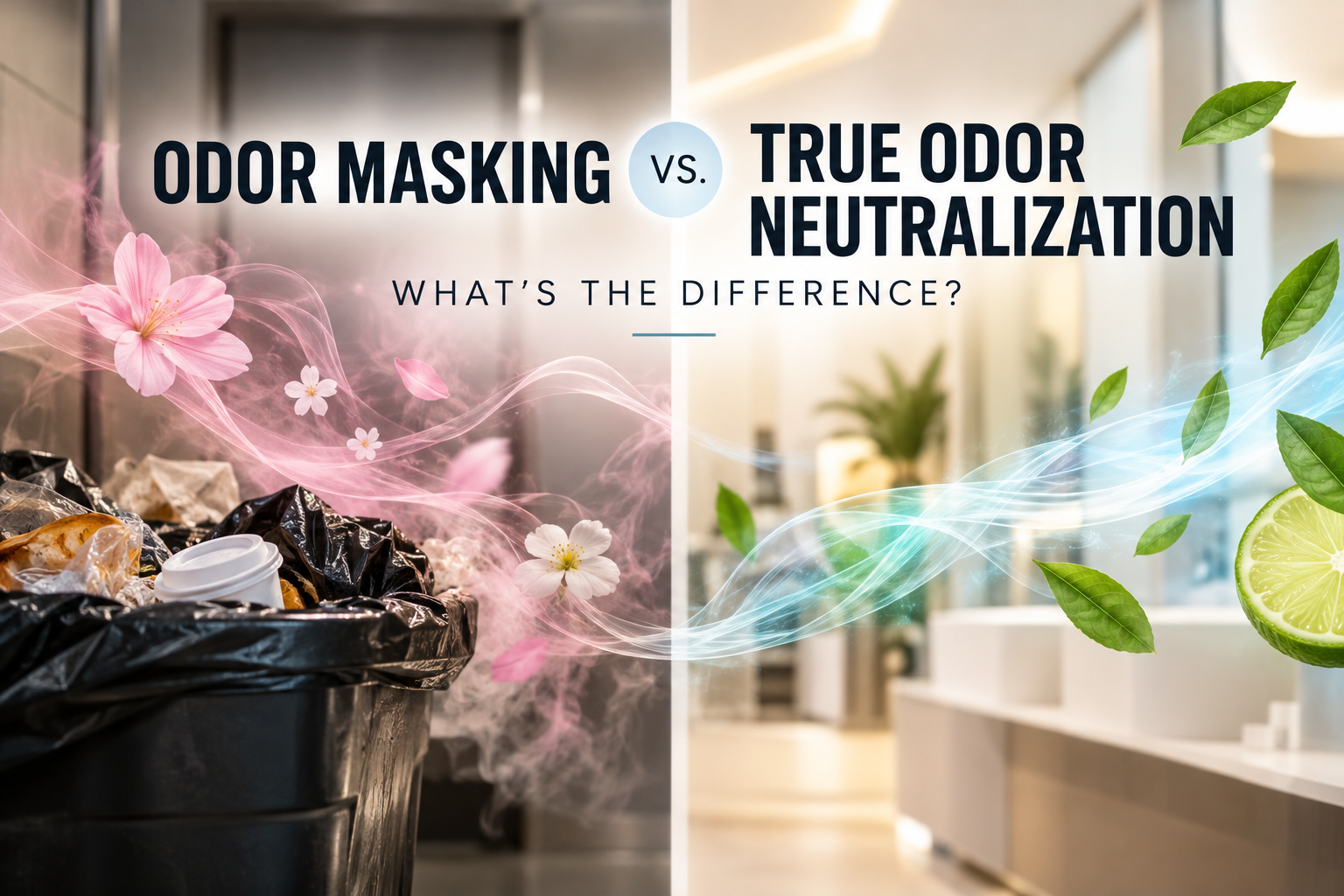
Have you ever walked into a public restroom that smelled like flowers...and a restroom at the same time?
Or opened a trash room that somehow smelled like fresh citrus and garbage?
Most of us have.
That combination tells you something important: someone tried to cover the odor, but they didn't actually reduce it.
This is the difference between odor masking and odor neutralization—and understanding that difference explains why some spaces always seem fresh while others only smell good for a few minutes.
What Is Odor Masking?
Odor masking is exactly what it sounds like.
A pleasant fragrance is introduced into the air to compete with an unpleasant odor. If the fragrance is strong enough, your brain notices the pleasant scent first, making the odor seem less noticeable.
The key word is seem.
The odor molecules are often still present. As the fragrance fades, the unwanted odor usually returns. Sometimes the two even blend together, creating an odd mix of "clean linen and locker room" or "vanilla and trash."
We've all experienced it, and we instantly recognize that something doesn't smell quite right.
Why Does This Happen?
Your sense of smell works by detecting tiny airborne molecules that reach receptors inside your nose.
Whether it's fresh coffee, smoke, flowers, or yesterday's lunch in the break room, every smell begins with molecules floating through the air.
When a traditional air freshener is sprayed, it releases additional fragrance molecules into that same air.
Now your nose detects both the pleasant fragrance and the unpleasant odor at the same time. If the fragrance is stronger, it may temporarily dominate what you notice—but the original odor hasn't necessarily gone anywhere.
That's odor masking.
What Is True Odor Neutralization?
Odor neutralization takes a different approach.
Instead of simply adding a stronger fragrance, odor-neutralizing technologies use specialized ingredients designed to counteract unwanted odors.
To understand the difference, consider what causes an unpleasant smell.
Odors from garbage, perspiration, food waste, and other sources come from airborne chemical compounds. When those compounds reach receptors inside your nose, your brain interprets their signals as a particular smell.
Odor-neutralizing technologies can interrupt this process in several ways.
1. Molecular Interaction
Certain odor-control ingredients interact with odor-causing compounds. Depending on the chemistry involved, these interactions can change how readily those compounds enter or remain in the air.
2. Odor Capture
Some technologies use specialized molecules that can physically capture volatile compounds.
For example, cyclodextrins have molecular structures capable of holding certain volatile substances within an internal cavity. This can reduce the availability or volatility of the captured compounds.
3. Sensory Odor Counteraction
Other ingredients work at the level of smell perception.
Research has demonstrated that certain odor molecules can suppress the response of olfactory receptors to other odor molecules.
In other words, some odor-control ingredients can make an unpleasant smell less detectable without necessarily removing the original compounds from the air.
The important distinction is that odor neutralization doesn't always mean destroying odor molecules. It means using a specific odor-control mechanism to reduce their presence, availability, or perceived intensity.
And that's very different from simply adding more perfume.
How Odor-Neutralizing Fragrances Work
Here's where modern fragrance technology becomes especially valuable for businesses.
Traditional fragrances primarily focus on introducing a pleasant scent.
Specially formulated odor-neutralizing fragrances are designed to do two things at once:
Help counteract certain unwanted odors.
Introduce a clean, pleasant fragrance into the environment.
The difference comes down to what's inside the fragrance.
Odor-neutralizing formulations incorporate specialized ingredients selected for their odor-counteracting properties.
When properly dispersed, these ingredients work alongside the fragrance to help reduce the impact of targeted unwanted odors.
Consider a fitness center locker room.
A traditional fragrance might introduce a strong citrus scent. But if perspiration-related odors remain noticeable underneath, visitors may still detect both smells.
An odor-neutralizing fragrance takes a more targeted approach.
Its specialized ingredients help counteract certain unwanted odors while the fragrance creates a fresh, welcoming atmosphere.
The effectiveness depends on the specific odor compounds, formulation, and conditions in the space.
The goal isn't to make the room smell like more fragrance. It's to make the unwanted odor less noticeable.
Not All Fragrances Neutralize Odors
This is one of the most important distinctions in professional scent marketing.
Not every fragrance contains odor-neutralizing technology.
A premium fragrance can create a beautiful atmosphere without containing ingredients specifically designed to counteract unwanted odors.
For many businesses, that's exactly what they need.
A hotel lobby might benefit from a sophisticated signature scent. An apartment leasing office might want a bright, uplifting fragrance that makes a memorable first impression.
But other environments face recurring odor challenges.
Environments like gyms, restrooms, waste rooms, and busy shared spaces prone to malodors often benefit from specially formulated odor-neutralizing fragrances that deliver targeted odor-control benefits.
Odor-neutralizing fragrances are specially formulated to help counteract unwanted smells rather than relying on fragrance strength alone.
This is why choosing the right fragrance matters.
The best choice isn't always the strongest scent. It's the formulation that best addresses the environment.
Why Professional Cold-Air Diffusion Matters
Even the right fragrance needs an effective delivery system.
Professional cold-air diffusion systems atomize liquid fragrance into extremely fine droplets and distribute them throughout a designated space.
Unlike a quick spray of air freshener, a programmable diffuser can deliver fragrance on a consistent schedule.
This offers several important advantages.
Consistent Coverage: Properly sized systems help distribute fragrance throughout the intended area instead of concentrating it in one location.
Controlled Intensity: Adjustable settings allow businesses to create a pleasant atmosphere without overpowering visitors.
Ongoing Odor Control: When an odor-neutralizing fragrance is used, scheduled diffusion regularly introduces its odor-counteracting ingredients into the space.
Less Guesswork: Businesses can maintain a more consistent scent experience without relying on employees to spray air freshener throughout the day.
One important distinction: the diffuser itself doesn't neutralize odors.
The odor-neutralizing ingredients provide the odor-control function. The diffuser distributes the formulation.
Together, they provide a practical approach to managing everyday scent challenges.
Where Odor-Neutralizing Fragrances Make a Difference
Some businesses face more demanding odor challenges than others.
Senior Living Communities
Hallways, dining areas, common spaces, and areas near resident rooms can experience lingering everyday odors.
Specially formulated odor-neutralizing fragrances can help counteract certain unwanted smells while creating a comfortable, welcoming atmosphere for residents and visiting families.
Hotels and Hospitality
Guest corridors, elevators, lobbies, and shared spaces experience constant activity.
Odor-neutralizing fragrances can help address certain everyday odors while maintaining a consistent guest experience.
Fitness Centers
Perspiration, equipment, and heavily used common areas create ongoing odor challenges.
Targeted odor-neutralizing fragrances can help reduce the impact of certain unwanted smells without simply introducing a stronger fragrance.
Apartments and Multifamily Communities
Elevators, hallways, leasing offices, and amenity spaces can experience odors from daily activity.
The right odor-neutralizing fragrance can help create a fresher atmosphere and a better first impression for prospective residents.
Of course, fragrance isn't a substitute for cleaning, proper ventilation, or eliminating the source of a persistent odor. Those steps remain essential.
Odor-neutralizing fragrances provide an additional layer of odor management.
Odor Masking vs. Odor Neutralization at a Glance
Odor Masking
Adds fragrance to compete with bad smells
Primarily relies on fragrance intensity
Unwanted odors may remain noticeable
May require stronger fragrance to dominate an odor
Focuses on adding a pleasant smell
Odor Neutralization
Uses specialized ingredients to counteract targeted odors
Uses physical, chemical, or sensory mechanisms
Helps reduce the impact or perception of certain odors
Can offer odor-control benefits without simply increasing fragrance strength
Focuses on odor control and the overall scent experience
The Fragrant Solutions Difference
At Fragrant Solutions, we believe a space should never smell like it's trying to hide something.
That's why we offer more than one approach to professional scenting.
Our commercial cold-air diffusion systems help businesses create consistent, welcoming fragrance experiences.
For spaces where unwanted odors present an additional challenge, we also offer specially formulated odor-neutralizing fragrances.
These fragrances incorporate advanced odor-counteracting technology designed to help reduce the impact of certain everyday airborne odors while delivering a pleasant, consistent scent.
The result is a more thoughtful approach to commercial scenting.
Some spaces simply need a beautiful signature fragrance.
Others benefit from a fragrance that also provides targeted odor-control properties.
Whether it's a senior living community, hotel, apartment building, fitness center, or office, the goal remains the same: create an environment that feels fresh, welcoming, and memorable.
The right fragrance doesn't just change what people smell. It can help change what they don't smell.
The Bottom Line
If you've ever thought, "It smells like they sprayed air freshener over the problem," you've experienced odor masking.
Odor neutralization offers another approach.
Rather than relying exclusively on stronger fragrance, specialized odor-neutralizing ingredients help counteract unwanted smells through targeted physical, chemical, or sensory mechanisms.
When paired with professional cold-air diffusion and a carefully selected fragrance, these technologies can help businesses maintain a more pleasant and consistent atmosphere.
Because when someone walks through your doors, you don't want them wondering what you're trying to cover up.
You want them noticing how good your space smells.
Sources & Further Reading
1. McClintock, T. S., et al. (2020). Mixture and Concentration Effects on Odorant Receptor Response Patterns In Vivo. Chemical Senses, 45(6), 429–438.
https://academic.oup.com/chemse/article/45/6/429/5840529
Research demonstrating how certain odor compounds can suppress olfactory receptor responses to other compounds, supporting the explanation of sensory odor counteraction.
2. Xiao, Z., et al. (2021). Cyclodextrins as Carriers for Volatile Aroma Compounds: A Review. Carbohydrate Polymers, 269, 118292.
https://pubmed.ncbi.nlm.nih.gov/34294318/
A scientific review explaining how cyclodextrins encapsulate volatile compounds, supporting the discussion of molecular odor capture.
3. Singer, M., et al. (2019). Eucalyptol Masks the Olfactory But Not the Trigeminal Sensation of Ammonia. Chemical Senses, 44(9), 733–741.
https://academic.oup.com/chemse/article-abstract/44/9/733/5572347
Research examining how a fragrance compound affects the perception of ammonia, illustrating the distinction between odor perception and complete odor elimination.